The P-Demo platform is Floating Power Plants first commercial-scale platform. The P-Demo is designed as flexible technology demonstrator, intended to showcase Floating Power Plants technology and use-cases. Deployed of the coast of Grand Canaria at the PLOCAN test site, it will deliver green energy on demand to the island. P-Demo is designed to be flexible and adaptable, enabling showcasing of different scenarios in different market segments. In the first phase the platform is deployed with a 4.3 MW wind turbine as well as an energy storage system.
This project serves as a pivotal demonstration, setting the stage for the widespread adoption of Floating Power Plants technology in the offshore Power-to-X market. By providing clean and cost-effective dispatchable power, P-Demo addresses the energy needs of offshore, off-grid, and coastal weak-grid applications, such as islands, that currently rely on fossil fuels.

In the first phase the P-Demo platform is deployed with a 4.3 MW Wind Turbine Generator, a hydrogen system comprising an electrolyzer, hydrogen energy storage, a fuel cell and a battery system.
An Energy management system ensures that the platform both help lower the carbon footprint of the island by shifting renewable energy from low- to high carbon intensity hours. Through the energy management system other scenarios in different market segments can be simulated.
This innovative system is projected to deliver over 11 GWh per year of renewable electricity to the grid, avoiding a total of 25,557 tonnes of CO2 equivalent during its first 10 years of operation.
In later projects stages other technologies can be implemented and demonstrated on the flexible platform.
The P-Demo project is being advice by an end-user advisory board consisting of representatives from potential end-users of FPPs technology. The board consist of three oil & gas majors, four utilities/developers and tier-1 industrial partners. Some advisory board members are confidential.
The guidance we receive form the board is crucial to ensure not only that the technology satisfy the needs of the end-users, but also that the offshore demonstration is adequate to eliminate risks.


Funded by the European Union. Views and opinions expressed are however those of the author(s) only and do not necessarily reflect those of the European Climate, Infrastructure and Environment Executive Agency (CINEA) via the EU Innovation Fund. Neither the European Union nor the granting authority can be held responsible for them.
Floating Power Plant has secured €26 million for the SEAWORTHY project to advance integrated offshore renewable energy. The P-Demo platform combines a 4.3 MW wind turbine, a 0.8 MW wave energy converter, and a hydrogen system. Deployed at PLOCAN’s test site in Spain, it will be the first unit integrating wind, wave, and hydrogen generation, producing 11 GWh annually
P-Demo optimizes wind and wave resources, incorporating hydrogen production, up to 300 MWh of storage, and fuel cells to deliver dispatchable renewable power. The design reduces investment per MW through shared infrastructure and shipbuilding-based production. SEAWORTHY supports the EU Offshore Renewable Energy Strategy and REPowerEU’s climate neutrality goals.
Floating Power Plant is a technology developer and integrator specializing in floating energy platforms. With a strong focus on innovation and sustainability, the company aims to deliver advanced solutions that harness the power of renewable energy sources, including wave and wind. Floating Power Plant is committed to driving the global transition towards clean and sustainable energy systems. Floating Power Plant comprises two key legal entities within the SEAWORTHY project. The primary beneficiary and coordinator of the project is Floating Power Plant Canaries SLU, based in Spain. Additionally, Floating Power Plant A/S, headquartered in Denmark, is a significant beneficiary contributing to the project’s success.
If you have any questions, please reach out to the project coordinator at fpp.canarias@floatingpowerplant.com
SEAWORTHY is a commercial-scale demonstration of a first-of-a-kind technology that is capable of supplying clean dispatchable offshore power from wind, waves and hydrogen (H2). The project will pave the way for the commercial roll-out of this technology, which will revolutionise the offshore Power-to-X market by providing clean and cost-effective dispatchable power to offshore, off-grid and coastal weak-grid applications (e.g. islands), which currently rely on fossil fuels.
This demonstrator technology, P-Demo, integrates a 4.3 megawatt (MW) Wind Turbine Generator (WTG), a 0.8 MW Wave Energy Converter (WEC) system and a H2 system consisting of a 1 MW electrolyser, 48 MWh of energy storage and a 1.2 MW fuel cell. P-Demo will be the world’s first wind-wave-H2 unit and it will be deployed in PLOCAN’s test site in Spain. It will deliver 11.05 Gigawatt hours (GWh) per year of renewable electricity to the grid, avoiding a total of 25 557 tonnes of CO2 equivalent during its first 10 years of operation, with a 100% relative greenhouse gas (GHG) emission avoidance.
These key innovative features of the project allow for a maximised uptake of wind and wave resources, increasing power quality, output capacity per unit and output consistency over time. At the same time, the project integrates H2 production systems, including electrolysers, a higher energy storage capacity (up to 300 MWh) and fuel cells, for the provision of truly dispatchable renewable power. These features in turn minimise the total investment per megawatt, through shared infrastructure (mooring, platform, and grid infrastructure) for the three technologies in a single unit, as well as manufacturing materials and techniques from the shipbuilding value chain that enable scaled series production and economies of scale.
In terms of policy priorities, the technology contributes directly to the EU Strategy on Offshore Renewable Energy, as well as to the longer term climate neutrality objectives. Moreover, REPowerEU recognizes that energy storage plays a key role to end external dependence on fossil fuels by ensuring security of supply and supporting renewables integration. Furthermore, the technological design allows a variety of manufacturing and assembly options, easing the use of different facility types and a distributed European supply chain. From a social perspective, this provides opportunities for a high degree of local content and job creation, even in geographical areas lacking a strong marine industry and where a suitable value chain can scale gradually.
In 2022, FPP and TechnipFMC completed a concept study for a North Sea client, evaluating renewable power supply for an offshore oil and gas platform. The study assessed a floating renewable system with hydrogen-based energy storage to replace an excisting gas turbine generator set up.
The study showed, that the concept could cover up to 80% of the platform’s annual energy demand, limit gas turbine generator use to under 50 starts/stops per year and reduce CO₂ emissions by over 60% while maintaining operational redundancy.
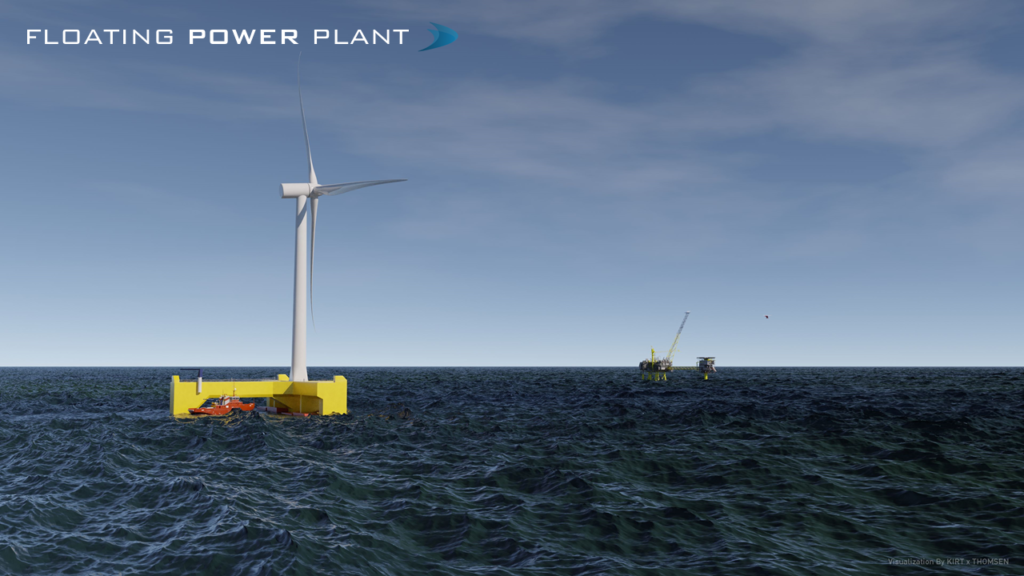
FPP carried out a study for the Harald platform in the Danish North Sea to explore sustainable power solutions for remote offshore operations and address renewable energy intermittency. In collaboration with industry leader TechnipFMC, the project focused on hydrogen-based energy storage.
By oversizing renewable energy capacity, the project enabled excess power to be converted into hydrogen. The hydrogyn could later be reused in fuel cells to maintain power supply during low-generation periods, providing a stable energy solution for Total Denmark.

FPP’s first O&G project evaluated the technology’s capability to power offshore oil and gas assets. The study – carried out for upstream oil and gas company Lundin – adapted the design to meet industry standards and operational requirements.
Multiple concepts were assessed, from intermittent renewable supply to baseload power with backup, and the system’s potential to directly power Enhanced Oil Recovery (EOR) equipment was explored, demonstrating its flexibility in the sector.