Test page status:
New projects page being developed
additions to technology page
Moved out of test page:
Technology and career content moved to respective pages
Investment moved to renamed page
New version of “About FPP”
Font test:
The Quick Brown
Fox Jumps Over
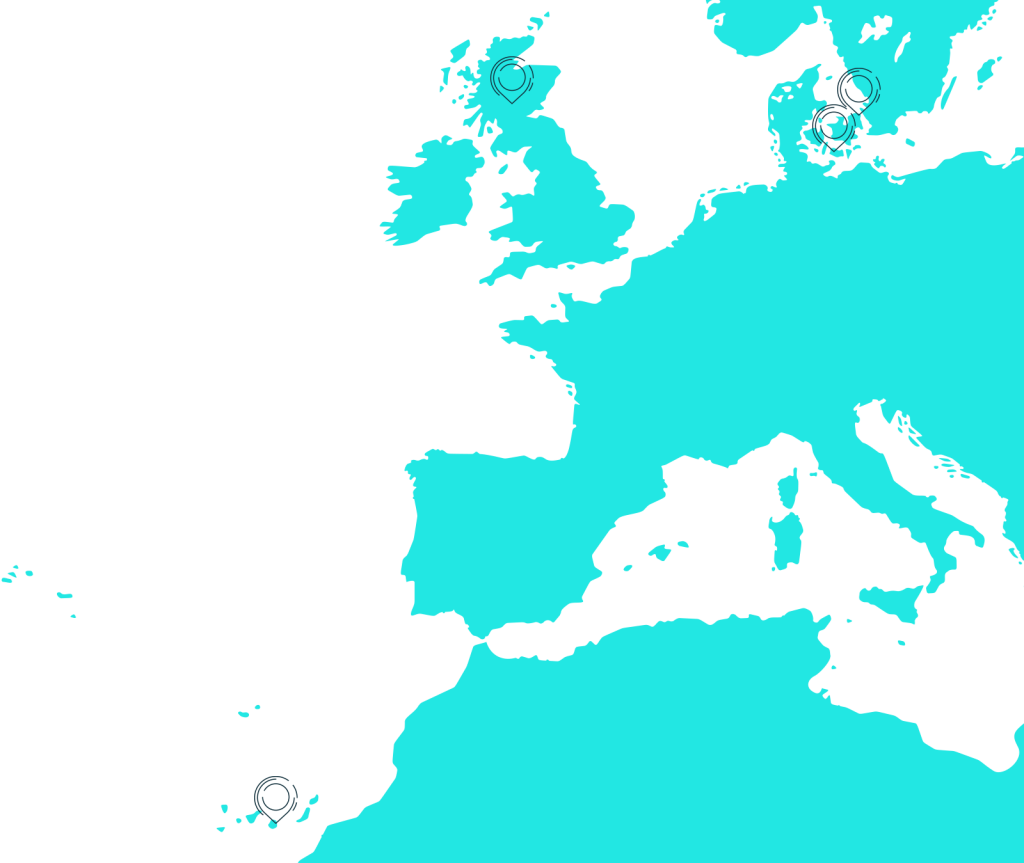
The P-Demo platform is Floating Power Plants first commercial-scale platform. The P-Demo is designed as flexible technology demonstrator, intended to showcase Floating Power Plants technology and use-cases. Deployed of the coast of Grand Canaria at the PLOCAN test site, it will deliver green energy on demand to the island. P-Demo is designed to be flexible and adaptable, enabling showcasing of different scenarios in different market segments. In the first phase the platform is deployed with a 4.3 MW wind turbine as well as an energy storage system.
This project serves as a pivotal demonstration, setting the stage for the widespread adoption of Floating Power Plants technology in the offshore Power-to-X market. By providing clean and cost-effective dispatchable power, P-Demo addresses the energy needs of offshore, off-grid, and coastal weak-grid applications, such as islands, that currently rely on fossil fuels.

In the first phase the P-Demo platform is deployed with a 4.3 MW Wind Turbine Generator, a hydrogen system comprising an electrolyzer, hydrogen energy storage, a fuel cell and a battery system.
An Energy management system ensures that the platform both help lower the carbon footprint of the island by shifting renewable energy from low- to high carbon intensity hours. Through the energy management system other scenarios in different market segments can be simulated.
This innovative system is projected to deliver over 11 GWh per year of renewable electricity to the grid, avoiding a total of 25,557 tonnes of CO2 equivalent during its first 10 years of operation.
In later projects stages other technologies can be implemented and demonstrated on the flexible platform.
The P-Demo project is being advice by an end-user advisory board consisting of potential end-users of FPPs technology. The board consist of three oil & gas majors, four utilities/developers and tier-1 industrial partners. Some advisory board members are confidential.
The guidance we receive form the board is crucial to ensure not only that the technology satisfy the needs of the end-users, but also that the offshore demonstration is adequate to eliminate risks.


Project facts:

The P-Demo platform is co-funded by the european union through the SEAWORTHY project.

Floating Power Plant has secured €26 million for the SEAWORTHY project to advance integrated offshore renewable energy. The P-Demo platform combines a 4.3 MW wind turbine, a 0.8 MW wave energy converter, and a hydrogen system. Deployed at PLOCAN’s test site in Spain, it will be the first unit integrating wind, wave, and hydrogen generation, producing 11 GWh annually
P-Demo optimizes wind and wave resources, incorporating hydrogen production, up to 300 MWh of storage, and fuel cells to deliver dispatchable renewable power. The design reduces investment per MW through shared infrastructure and shipbuilding-based production. SEAWORTHY supports the EU Offshore Renewable Energy Strategy and REPowerEU’s climate neutrality goals.
In 2022, FPP and TechnipFMC completed a concept study for a North Sea client, evaluating renewable power supply for an offshore oil and gas platform. The study assessed a floating renewable system with hydrogen-based energy storage to replace an excisting gas turbine generator set up.
The study showed, that the concept could cover up to 80% of the platform’s annual energy demand, limit gas turbine generator use to under 50 starts/stops per year and reduce CO₂ emissions by over 60% while maintaining operational redundancy.

FPP carried out a study for the Harald platform in the Danish North Sea to explore sustainable power solutions for remote offshore operations and address renewable energy intermittency. In collaboration with industry leader TechnipFMC, the project focused on hydrogen-based energy storage.
By oversizing renewable energy capacity, the project enabled excess power to be converted into hydrogen. The hydrogyn could later be reused in fuel cells to maintain power supply during low-generation periods, providing a stable energy solution for Total Denmark.


FPP’s first O&G project evaluated the technology’s capability to power offshore oil and gas assets. The study – carried out for upstream oil and gas company Lundin – adapted the design to meet industry standards and operational requirements.
Multiple concepts were assessed, from intermittent renewable supply to baseload power with backup, and the system’s potential to directly power Enhanced Oil Recovery (EOR) equipment was explored, demonstrating its flexibility in the sector.

We integrate green technologies into our floating platform…

… to provide Green energy on demand

Floating Power Plant’s technology has been thoroughly tested through simulations, laboratory experiments, and full-scale offshore demonstrations. The modular design allows for cost-effective and locally adaptable solutions.
The technology has been verified at sea under real operating conditions, including grid connection through one of Ørsted’s offshore wind farms.
The system ensures a stable and reliable power supply by optimizing when, where, and how energy is delivered.
The modular approach also makes it possible to distribute major contracts between local, specialized, and low-cost suppliers, achieving an effective balance between local content, cost, and quality.


Modularity: A Flexible Technology Solution
The system is built on a modular design that allows adaptation to each site’s specific conditions. The core components—platform, wind turbine, and mooring system—can be complemented with optional elements such as hydrogen units (for export or storage), battery systems, or wave energy converters.
This modular approach enables efficient customization to match local requirements and project objectives.
Our entire power plant is based around a T-shaped semi-submersible platform, built from cost-effective panel sections (sheet steel and stiffeners) – a method commonly used in ship building. This design reduces costs, minimizes supply chain bottlenecks, offers local content optimization, and creates a large indoor space. This protected and dry space can accommodate various equipment. Building on proven offshore technologies, our platform is the indispensable foundation of our solution.


Wind energy stands as one of the most well-established, efficient, and reliable renewable technologies available. At the core of our power plant, the wind turbine generator harnesses this vast energy resource available offshore. We typically work with top-tier wind turbine manufacturers; however, our design is turbine agnostic so we can work with our clients’ preference for wind turbines if required. The wind turbine generator is an essential component of our floating system.
Harnessing the vast renewable energy resource available offshore is only the first step, meeting the energy demands of the end user is key to achieving net zero. To support this, we can incorporate hydrogen systems onto the platform, allowing us to convert surplus energy into hydrogen. This hydrogen can be stored on the platform and converted back into power through a fuel cell in periods no or low wind production. This enables the platform to deliver truly dispatchable green energy. Our platform has the capacity to store up to 300 MWh of electrical energy, providing an efficient energy storage solution to enhance system flexibility and sustainability. It is also possible to transmit the produced hydrogen to the mainland through pipelines to meet the growing demand for green hydrogen for Power-to-X applications and alternative fuels.


A battery system offers same concept as the hydrogen system – storing excess energy for use later. A battery system can however react faster to variations in supply and demand but offers lower storage capacity. This makes a battery system in projects where only short time energy storage is needed or in combination with at hydrogen system to create a true stable micro grid.

The platform is kept in position using a mooring system consisting of chains and rope connected to the platform and leading to anchors on the seabed. As standard, a “spread mooring” is used, where the lines attach to the platform at the ends of the T shape and spread out equally. Alternatively, a turret could be utilized where wave energy is incorporated and the ability to rotate is deemed beneficial in design. The mooring system is an essential element that ensures the stability and functionality of the platform.
Our innovative system offers the option of including Wave Energy Convertors (WECs) consisting of wave absorbers and power take-off systems, enabling the transformation of wave energy into electricity. This capability allows us to maximize power production at suitable sites. Moreover, as waves persist even after the wind has dropped, the energy derived from this component is often more valuable. The benefits of the WECs will vary from site to site and depend on the project requirements, a screening analysis at the early stage of a project can quickly determine the appropriateness for a specific project.